Events

October 2024

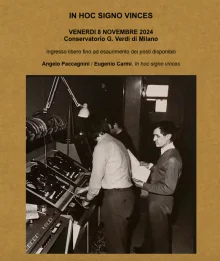
Concert "In Hoc Signo Vinces", from the project by Angelo Paccagnini and Eugenio Carmi

Foyer Alto, Sala Verdi – 2 pm Introduction and opening
Part one: archives and sources
2.15 pm Maria Maddalena Novati: NoMus trailer and a look at the Paccagnini collection
2.35 pm Prof. Marina Vaccarini: The score of In hoc signo vinces: findings and hypotheses
2.55 pm Arch. Giulio Masoni: The Carmi/Paccagnini collaboration between art history and design
3.15 pm Questions and discussion
Part two: from the collaboration, through the sources, to the performance
Chairs: Laura Zattra and Davide Gagliardi
4 pm Gaetano Liguori: Paccagnini between rigour and improvisation
4.25 pm Goffredo Haus: The multimedia experiments of Paccagnini/Carmi
4.45 pm Conservatory ensemble, Davide Gagliardi and Laura Zattra: From the sources to the performance
5.30 pm Questions, final discussion, presentation of the concert
6 pm End
6.30 pm Performance of In Hoc Signo Vinces – Sala Puccini

In collaboration with the Conservatorio di Milano and the Associazione NoMus

February 2024

Cromosinclasmi – a multimedia story – MuseoCity, 1–5 March

“The cromosinclasmi are moments of a story whose protagonists are a projector, a camera, some paintings, the author of these paintings and a woman.”
Michelangelo Antonioni, 1971

MuseoCity, 1–5 March 2024

February 2023

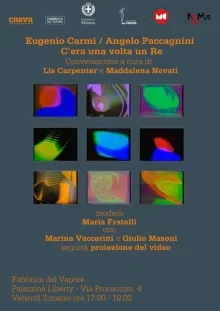
C'era una volta un re – MuseoCity with CASVA and Associazione NoMus

Friday 3 March, 5–7 pm, talk | PACCAGNINI/CARMI Luce e musica (Light and music)

The NoMus association and CASVA present the Eugenio Carmi Archive with a conversation at Fabbrica del Vapore, "PACCAGNINI/CARMI Luce e musica", curated by Lis Carpenter and Maddalena Novati, on C'era una volta un re (Once upon a time there was a king), Eugenio Carmi's experimental video with electronic music by Angelo Paccagnini. Speakers: Marina Vaccarini, Giulio Masoni. Chair: Maria Fratelli.

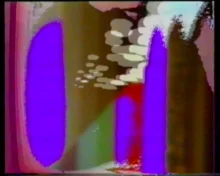
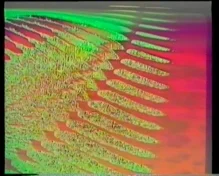
The work will be screened. Conceived specifically for television, it is innovative in its use of dissolves between images, its colour and the electronic sounds made at the RAI's Studio di Fonologia Musicale in Milan. Angelo Paccagnini's electronic music was obtained by processing Carmi's visual signals and translating them into sound with a synthesizer. The parallel development of Paccagnini's sounds and Carmi's images reveals fortunate thematic and formal connections, culminating in moments of synchrony.

Free entry, booking required on the MuseoCity website.

A repeat follows on Saturday 4 March at the Associazione NoMus.

February 2022

SPCE - MuseoCity Milano 2022

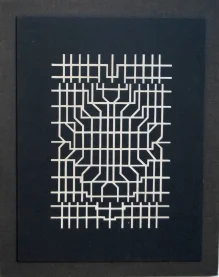
SPCE - electronically controlled polycyclic structure: this was the name penned by Gillo Dorfles for the image generating machine invented by Eugenio Carmi in 1966. On view are four historic seriagraphs created during the 1966 Venice Biennale and rare photos of the production process by Lisetta Carmi.

Entry 2 visitors per turn during this special weekend with Super Green Pass.

Reservations a must: info@eugeniocarmi.eu

February 2021

Milano MuseoCity 2021

Special opening from 3 to 5 March 2021: Wednesday 9:30–12:30, Thursday 14:00–17:00, Friday 14:00–17:00.

Bookings: info@eugeniocarmi.eu

December 2020

Available now - Eugenio Carmi. The Time Between Parentheses

In celebration of the centenary of his birth, this video by Roberta Cordisco explores various periods of the artist’s life. English subtitles (CC) can be turned on in the menu bar below the video.

Watch the video on memomi.it

November 2020

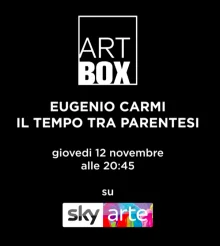
Eugenio Carmi, The Time Between Parentheses

Produced by 3D Produzioni and curated by Roberta Cordisco, the film retraces moments of Eugenio Carmi's work through footage, interviews and narration. It will be shown four times on Sky Arte and will then be available on this website.

October 2020

The Galleria del Deposito on show in Genoa

Opening Thursday 8 October, 6 pm to midnight

Exhibition open Tuesday to Saturday, 4 pm to 7.30 pm (by appointment)

Galleria Martini & Ronchetti, via Roma 9, Genoa

As part of START Genova 2020, Galleria Martini & Ronchetti opens I fabbricanti di immagini. La Galleria il Deposito: avanguardia a Genova 1963–1969 (The image makers. The Galleria del Deposito: avant-garde in Genoa 1963–1969), an exhibition that retraces, through a selection of works, the key figures of one of the most interesting artistic adventures of the 1960s in Italy.

On 23 November 1963, in Genoa-Boccadasse, in a small former coal store, the Galleria del Deposito opened its doors. It helped to promote the great protagonists of contemporary art of the 1960s in Italy and abroad.

It was founded by the art and culture association Gruppo Cooperativo di Boccadasse, set up by nine founding members – Bruno Alfieri, Kurt Blum, Flavio Costantini, Germano Facetti, Carlo Fedeli, Emanuele Luzzati, Achille Perilli, Kiki Vices-Vinci and the initiator of the project, Eugenio Carmi – with the aim of "bringing the visual arts up to date".

Besides exhibitions, meetings and debates, the Deposito was the first in Italy to invent and produce multiples: works in limited, numbered and signed editions. A monthly newsletter, in Italian and English, presented the works and was sent to international museums and galleries, to reach a wide public and break down the economic barriers to the circulation and enjoyment of art.

The founders were soon joined by established critics such as Gillo Dorfles, Germano Beringheli and a young Germano Celant, and by artists such as Lucio Fontana, Jesús Rafael Soto, Victor Vasarely and Richard Paul Lohse.

During its years of activity the Galleria del Deposito held thirty-seven events, solo exhibitions and cultural programmes, showing both emerging artists such as Getulio Alviani and Paolo Scheggi and established names such as Piero Dorazio and Enrico Castellani. The stimulating climate led Lucio Fontana to create an "ambiente nero" (black environment), his second environment under Wood's light, inside the Deposito. The gallery became a magnet for collectors and intellectuals until May 1969, when the Cooperativa di Boccadasse came to an end; production continued for a while in Eugenio Carmi's studio at via Roma 10.

The exhibition shows both unique works and multiples – object-sculptures and screen prints. Among the unique works are pieces by Eugenio Carmi, Corrado Cagli, Flavio Costantini (a large work on paper from 1962) and Gianfranco Baruchello (a mixed-media work from 1970), as well as works by Emilio Scanavino from the 1960s, a work on paper by David Smith from 1962, two works by Vasarely from 1960/70 and an assemblage by Antoni Miralda. Among the multiples: Cubo by Max Bill, Rilievo by Castellani, Strutturazione acentrica by Colombo, a Concetto spaziale by Fontana made as a scarf with holes and rivets, a sculpture by Pomodoro, inter-ena-cubo (1965) by Paolo Scheggi, Incliné bleu et noir (1966) by Jesús Rafael Soto, a Rilievo by Kiki Vices-Vinci, three Rilievo medio by Andreas Christen and Spazio-clap by Eugenio Carmi. Among the screen prints are works by Konrad Wachsmann, Achille Perilli, Wilfred Gaul, Marcello Morandini, Piero Dorazio, Emanuele Luzzati, Getulio Alviani, Richard Lohse and Max Bill.

July 2020

Museo del Novecento

INCONTRI [IM]POSSIBILI – Masterpieces from the storerooms of the Museo del Novecento

On 30 June 2020 the Museo del Novecento in Milan presented Eugenio Carmi’s Appunti, 1963, on its social media channels.

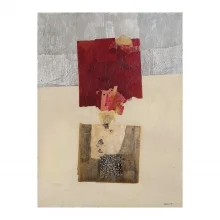
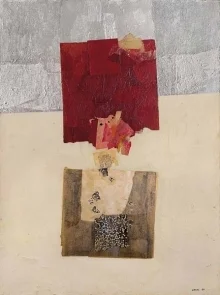
“Since the early 1950s Eugenio Carmi has been one of the leading exponents of Italian abstract art. The collage on canvas Appunti (Notes, 1963) was donated by the artist to the Museo del Novecento in 2014, confirming his strong bond with Milan, his adopted city, where he lived from 1971. The cycle of collages on canvas of 1962–63, to which the work belongs, is a pivotal moment in Carmi’s artistic production. It is in fact a summa of the path he had followed until then and of the influences and stimuli he had gathered: from his work as a graphic designer to the artistic scene in Genoa, Italy and abroad in the second half of the 1950s. The works and collages are notes on what exists and happens around him: the natural, urban and industrial landscape, history and current events. The artist is a careful observer of ‘things’, but also of people and society. It is a lucid curiosity, an ability to observe and to distil forms and colours, structures and signs.”

Danka Giacon, curator at the Museo del Novecento

The post on Instagram

February 2020

Eugenio Carmi was born 100 years ago

For the centenary of Eugenio Carmi's birth, the newspaper "La Repubblica" remembered him with a fine article by Alessandro Cassinis (in Italian).

Read the article

February 2020

Stripsody in Dublin

Do Re Quack Gulp: How Cathy Berberian turned comic strips into music scores

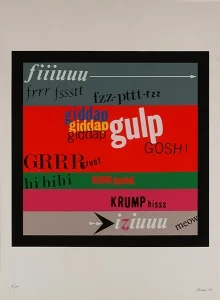
In 1966 Cathy Berberian — called ‘Callas of the avant-garde’ by numerous contemporary composers — was in search of new vocal stimuli. With the support of Umberto Eco, her friend and admirer, she composed and performed a “Comics Opera” made of a series of comic-strip onomatopoeias. The painter Eugenio Carmi then joined in and illustrated the material. The Stripsody project was born.

Eleonora Lima (TCD) and Francesca Placanica (University of Maynooth) will discuss how comics, music, and visual arts came together in this extraordinary collaboration centering the larger-than-life talent of Cathy Berberian.

Event supported by the AHRC-funded project Interdisciplinary Italy: Interart/Intermedia.

Event in English.

Free admission, booking recommended.

Info here.

April 2019

Eugenio Carmi's "Stripsody" on show in Rome

Il corpo della voce. Esplorare la voce tra scienza, teatro e canto – Carmelo Bene, Cathy Berberian, Demetrio Stratos (The body of the voice. Exploring the voice between science, theatre and singing)

9 April – 30 June 2019

Palazzo delle Esposizioni
Via Nazionale 194, Rome

www.palazzoesposizioni.it

The exhibition is devoted to the voice as pure sound potential. It retraces the events which, following the avant-gardes of the twentieth century, broke the bond between the meaning of words and their sound, through works by three extraordinary figures: the American mezzo-soprano of Armenian origin Cathy Berberian (1925–1983), the actor and director Carmelo Bene (1937–2002) and the singer and musician of Greek origin Demetrio Stratos (1945–1979). Their innovative research and experimentation take visitors on an original journey of discovery of this fundamental human potential.

More than 120 items are on show: photographs, videos, archive material, original scores, letters and documents shown for the first time, as well as interactive exhibits, listening areas and the electronic equipment the artists used to explore the limits of their voices. The material was gathered from several archives thanks to the careful research of the curators, Francesca Rachele Oppedisano and Anna Cestelli Guidi.

STRIPSODY

Stripsody, a series of 14 screen prints made by Eugenio Carmi in 1967, is part of the exhibition.

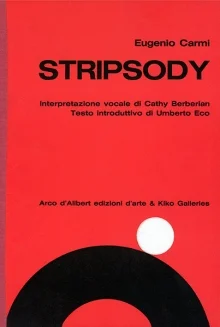
In 1966 Cathy Berberian – "the greatest living singer of contemporary music", in Umberto Eco's words – was looking for new vocal material for an experimental composition. Eco suggested she perform a series of comic-strip onomatopoeias, and immediately thought of Eugenio Carmi because "it seemed obvious that Carmi was the man who could visualise that material". The meeting between the two artists was at once a mutual stimulus and the start of a great friendship. "Cathy was an indescribable artist, an erupting volcano, and her figure was one with her voice and her gestures"; Carmi made 14 plates: "I shut myself in my studio in Boccadasse and listened to Cathy's singing dozens of times on the record player. That is how I managed to produce, in a month, 14 images in which all the sung onomatopoeias had become readable."

Cathy Berberian performed the piece with great success at the Bremen Festival, and Eugenio Carmi showed the images at the Galleria Arco d'Alibert in Rome, which published the book Stripsody: Carmi's plates, the 45 rpm record of Cathy Berberian's performance and an introduction by Umberto Eco, who also wrote a glossary giving a meaning to each onomatopoeia. An English edition was published by the Kiko Gallery in Houston, which made a series of screen prints from Carmi's plates. The screen prints became the set for all of Cathy's later performances of Stripsody.

More about Stripsody

February 2019

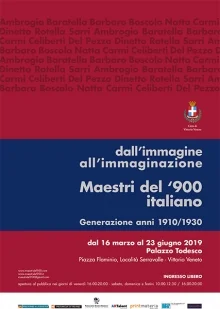
Masters of 20th-century Italian art, born 1910–1930

Works by Eugenio Carmi are in the exhibition Dall'immagine all'immaginazione. Maestri del '900 italiano, Generazione anni 1910/30 (From image to imagination. Masters of 20th-century Italian art, born 1910–30).

From 16 March to 23 June 2019

Palazzo Todesco
Piazza Flaminio, Serravalle – Vittorio Veneto

Open:
Friday 16.00–20.00
Saturday, Sunday and holidays 10.00–12.30 / 16.00–20.00

Curated by Maurizio Pradella

About a hundred and thirty works by historic masters will be shown: Gianni Ambrogio, Paolo Baratella, Saverio Barbaro, Domenico Boscolo Natta, Eugenio Carmi, Giorgio Celiberti, Lucio Del Pezzo, Lino Dinetto, Mimmo Rotella, Sergio Sarri.

Information:

www.maestridel900.com

Ufficio cultura – tel. +39 0438 569310
maestridel900@gmail.com

January 2019

Current exhibitions featuring Eugenio Carmi

Made in Italy: MITA Textile Design 1926–1976
16 November 2018 – 28 April 2019

The Wolfsonian–FIU
1001 Washington Avenue
Miami Beach, Florida, USA

Artists' textiles: art and design in MITA's production 1926–1976

The exhibition tells the story of MITA, the Manifattura Italiana Tappeti Artistici founded in Genoa Nervi by Mario Alberto Ponis in 1926 and active until the early 1970s. An original figure with a strong entrepreneurial flair, Ponis opened a workshop in Nervi making hand-knotted wool carpets, which soon also specialised in tapestries and then furnishing fabrics. He called on some of the most important artists of the time: Fortunato Depero, Arturo Martini, Gustavo Pulitzer, Gio Ponti and the architects of the Milanese Novecento (Tomaso Buzzi, Paolo Buffa, Emilio Lancia, Gigiotti Zanini), and later Mario Sironi, Oscar and Fausto Saccorotti, Emanuele Rambaldi, Eugenio Carmi, Flavio Costantini, Emanuele Luzzati, Enrico Paulucci, Arnaldo Pomodoro, Emilio Scanavino, Ettore Sottsass Jr. and Luigi Vietti.

The exhibition is organised by The Wolfsonian–Florida International University, Miami Beach, and La Wolfsoniana–Palazzo Ducale Fondazione per la Cultura, Genoa, in cooperation with the Consulate General of Italy in Miami.

Information: www.wolfsonian.org

100% ITALIA. CENT'ANNI DI CAPOLAVORI
21 September 2018 – 10 February 2019

Conceived and coordinated by Andrea Busto. Curated by Luca Beatrice, Lorenzo Canova, Claudio Cerritelli, Marco Meneguzzo, Elena Pontiggia, Luigi Sansone and Giorgio Verzotti.

The exhibition is spread over several venues.

Biella: Palazzo Gromo Losa and Museo del Territorio Biellese
Turin: MEF – Museo Ettore Fico, MEF Outside, Mastio della Cittadella, Palazzo Barolo
Vercelli: Arca – former church of San Marco

Eugenio Carmi's work is at MEF – Museo Ettore Fico, Turin.

Information:

MEF – Museo Ettore Fico
Via Francesco Cigna 114, 10155 Turin
Offices +39 011 853065
Tickets +39 011 852510
info@museofico.it
www.museofico.it

November 2018

Made in Italy: MITA Textile Design 1926–1976

November 16, 2018–April 28, 2019

The Wolfsonian–FIU
1001 Washington Avenue
Miami Beach - Florida - USA

Art and design, modern industry and handcraft—these were the ingredients brought together by MITA, an Italian firm specializing in carpets, tapestries, and other textiles. Founded in Genoa as the Manifattura Italiana Tappeti Artistici (Italian Artistic Carpet Manufactory) in 1926 by Mario Alberto Ponis, MITA earned its reputation by collaborating with some of Italy’s most talented artists and designers to create carpets inspired by modernist aesthetic trends while employing up-to-date production techniques. After the Second World War, MITA expanded production to include tapestries and fabrics with both abstract and figurative patterns—striking designs that secured lucrative commissions, decorated ocean liners, and were showcased in international exhibitions.

Carpets, tapestries, scarves, and printed fabrics, as well as original design drawings, will showcase exceptional work by designers like Gio Ponti, Fortunato Depero, Enrico Paulucci, Emanuele Luzzati, Arnaldo Pomodoro, Gio Pomodoro, and Ettore Sottsass, Jr., revealing a characteristically Italian approach to industry and design.

Made in Italy: MITA Textile Design 1926–1976 is organized by The Wolfsonian–Florida International University in Miami Beach and The Wolfsoniana–Palazzo Ducale Fondazione per la Cultura in Genoa, in cooperation with the Consulate General of Italy in Miami. Additional support is provided by the Consular Agency of the United States of America in Genoa, Mediterranean Shipping Company S.A., Blu Logistics Italia Srl, and Dietl International Services.
From the Wolfsoniana's Website Press Release

Info: www.wolfsonian.org

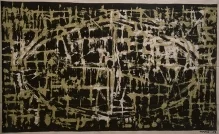
Image on the right: Eugenio Carmi, Mulinello, 1957, silkscreen printing on cotton

September 2018

100% ITALIA. A hundred years of masterpieces

A work by Eugenio Carmi is in the exhibition
100% ITALIA. CENT'ANNI DI CAPOLAVORI (A hundred years of masterpieces).

From 21 September 2018 to 10 February 2019

Conceived and coordinated by Andrea Busto. Curated by Luca Beatrice, Lorenzo Canova, Claudio Cerritelli, Marco Meneguzzo, Elena Pontiggia, Luigi Sansone and Giorgio Verzotti.

The exhibition is spread over several venues.

Biella: Palazzo Gromo Losa and Museo del Territorio Biellese
Turin: MEF – Museo Ettore Fico, MEF Outside, Mastio della Cittadella, Palazzo Barolo
Vercelli: Arca – former church of San Marco

Eugenio Carmi's work is at MEF – Museo Ettore Fico, Turin.

Information:

MEF – Museo Ettore Fico
Via Francesco Cigna 114, 10155 Turin
Offices +39 011 853065
Tickets +39 011 852510
info@museofico.it
www.museofico.it

September 2018

Carmi's "Specchi" at Galleria Consadori, Milan

Galleria Anna Maria Consadori, via Brera 2, Milan, presents the exhibition
"Metallo bianco lucente – le età dell'argento" (Shining white metal – the ages of silver).
On show is one of Carmi's "Specchi" (mirrors), made for Acerbis International (Seriate, Bergamo) in the 1980s.

Opening Wednesday 12 September 2018, 6 pm

From the gallery's press release:

"Metallo bianco lucente – le età dell'argento presents works by artists (such as Carmelo Cappello, Pietro Consagra, Eugenio Carmi, Franco Grignani, Turi Simeti, Arturo Vermi), designers (such as Ingo Maurer, Gio Ponti, Lino Sabattini, Carla Venosta, Nanda Vigo) and modern and contemporary photographers who have used silver in their work."

Information and opening hours: galleriaconsadori.com

September 2017

School teaching and the art of Eugenio Carmi

Young people and teaching always mattered a great deal to Eugenio Carmi.

For Carmi, art was a means of education and a way into the creative potential within each of us, as his own words show:

"I remember a visit to a primary school in Taranto for a discussion. When I entered the classroom, after brief introductions, the teacher pointed to a little girl with her head down and said: 'There's nothing to be done with that one, she can't even hold a pencil.' I went over to her. She was very shy, with two big dark eyes; she didn't dare speak, completely held back at home and at school. I talked with her for five minutes, trying to evoke images of everyday life. It was wonderful, for her and for me. She looked at me and I asked her to make me a drawing. She did, and it was a good drawing too. For the first time, through a natural human relationship, she had set her creativity free."

We are very happy to know that his work is still a source of inspiration for teachers and pupils. Sofia Iovine, Milena Botta, Michela D'Ambrosio, Santa Fiengo and Mara Serpe, teachers of classes I and II E at the I.C. D. Cimarosa primary school in Naples, tell us about it. Last school year they worked creatively on reading Gli gnomi di Gnu by Umberto Eco and Eugenio Carmi.

As Sofia Iovine writes:
"Eugenio Carmi's lively, colourful pictures helped the children listen, and they learned to love his collages and his typically sketched figures. But the work did not stop there. In five further two-hour sessions the two classes 'visited' Carmi's works virtually. They also watched the video C'era una volta un re, which the teachers found on the artist's website. The children were struck by the moving abstract forms and responded with great interest and curiosity. They then asked to reinterpret the artist's works. They were clearly very motivated to make an illustrated book with their own hands and imagination, and their enthusiasm showed in their care, attention and wish to do their best.

The project went through several stages:

- dividing the book Gli gnomi di Gnu into sequences
- making new illustrations inspired by Eugenio Carmi's techniques
- making an animated film for the school website
- an exhibition of the children's original drawings, open to the community

This education through images sparked the children's curiosity and widened their perception and thinking. It follows a precise choice of method, applied from the first year with the Biblioteca di Lavoro alongside the ministerial textbooks."

Istituto Comprensivo Statale Domenico Cimarosa

We hope many schools use this approach to education, because it engages and enthuses, helps long-term memory and reasoned thinking, and shows what interdisciplinarity means. In short, it shapes creative and capable adults.

September 2017

Carmi in other Collections

Eugenio Carmi (member of the Alliance Graphique International since 1954) made an important contribution to the Italian graphic arts of the 1950s and 1960s. Apart from his role at Italsider, Carmi was responsible for many visual communication works for firms large and small. See some examples in the AIAP Archive Collection.

For Contacts:

CDPG / Aiap
via Amilcare Ponchielli, 3
20129 Milano
Tel. 02.29520590
www.aiap.it

April 2017

The Video C’era una volta un re (1973) by Eugenio Carmi will be present in the exhibition "TV 70: Francesco Vezzoli Guarda la RAI" at Fondazione Prada

9 May - 24 September 2017

FONDAZIONE PRADA - MILAN
GALLERIA NORD
Section: Art and Television

The section “Art and Television”, introduced by Paesaggi TV (1970) by Mario Schifano in its first part, will create a parallel between 8 excerpts from TV shows on art, like Io e… and Come nasce un’opera d’arte, and the works of the artists featured in them: Vincenzo Agnetti, Gianfranco Baruchello, Alighiero Boetti, Alberto Burri, Giorgio de Chirico, Renato Guttuso, Michelangelo Pistoletto and Emilio Vedova. The exhibition will further explore the connection between contemporary art and TV language, pairing an installation by Giulio Paolini Apoteosi di Omero (1970-71) with 4 films that testify the artist’s collaboration with Rai for the realization of set designs for TV productions of literary classics such as Don Quixote and Moby Dick, or theater plays by Henrik Ibsen and Massimo Bontempelli. The exhibition will also showcase 2 works produced by Rai in which the television screen becomes a means for aesthetic and linguistic experimentation, such as Il televisore che piange (1972) by Fabio Mauri and C’era una volta un re (1973) by Eugenio Carmi.

For information:

FONDAZIONE PRADA - MILAN
LARGO ISARCO, 2
20139 MILAN - ITALY
Tel. +39.02.5666 2611
info@fondazioneprada.org

http://www.fondazioneprada.org

March 2017

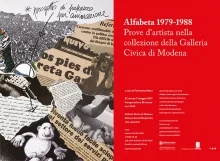
Alfabeta 1979-1988. Artist's proofs in the collection of the Galleria Civica di Modena

Alfabeta 1979-1988.
Prove d'artista nella collezione della Galleria Civica di Modena (Artist's proofs in the collection of the Galleria Civica di Modena)
curated by Francesca Mora
Galleria Civica di Modena, Palazzo Santa Margherita, 26 March – 7 May 2017

Opening Saturday 25 March, 6 pm, upper rooms of Palazzo Santa Margherita.

The exhibition, made possible also thanks to Fondazione Mudima, Milan, is devoted to the 66 artist's proofs made by 49 artists for the historic cultural magazine "Alfabeta" between 1983 and 1988. This group of works on paper (drawings, collages, prints and photographs), among the first to enter the collection of the Galleria Civica di Modena in the late 1980s after the monthly closed, is a rare and valuable cross-section of an important cultural phenomenon, driven by the spirit of the neo-avant-garde.

Published in Milan from 1979 to 1988 by an editorial board of Nanni Balestrini, Maria Corti, Gino Di Maggio, Umberto Eco, Francesco Leonetti, Antonio Porta, Pier Aldo Rovatti, Gianni Sassi, Mario Spinella and Paolo Volponi, "Alfabeta" was the voice of intellectuals of different backgrounds and interests, united by their active part in the cultural, social and political debate of the 1960s and 70s, and later by their reflection on what role they could play in the "ideologically confused" society of the early 1980s.

The artist's proofs began to appear in the magazine from issue 44, January 1983, with a drawing by Fausto Melotti. The more than sixty contributions that followed became a regular feature, entrusted to artists, writers and poets of different generations (from historic figures born in the early twentieth century to the youngest, born in the 1950s), styles (from Arte povera to Informale, from Op art to visual poetry) and languages: artists working in sculpture, installation, drawing, printmaking or design such as Enrico Baj, Alighiero Boetti, Eugenio Carmi, Emilio Isgrò, Ugo La Pietra, Alessandro Mendini, Claudio Olivieri, Concetto Pozzati, Toti Scialoja and William Xerra, among others, together with members of Gruppo 63 such as Luigi Malerba and Gianfranco Baruchello.

Besides the published drawings, the exhibition shows unpublished proofs, video accounts by some of the protagonists and issues of the magazine in digital form.

The 66 works, acquired by the Galleria Civica in 1989 with the support of CME Consorzio Modenese Edili (now CME Consorzio Imprenditori Edili Soc. Coop.), belong to the drawing collection started in 1988 by Flaminio Gualdoni, then director of the gallery, which today counts over 4,000 sheets by contemporary artists, a record of twentieth-century Italian drawing.

Works by:
Rina Aprile, Enrico Baj, Paolo Baratella, Gianfranco Baruchello, Alighiero Boetti, Anna Valeria Borsari, Eugenio Carmi, Giovanni Carta, Tommaso Cascella, Loriana Castano, Pietro Coletta, Giovanni D'Agostino, Dadamaino, Sergio Dangelo, Piero Del Giudice, Lucio Del Pezzo, Beppe Devalle, Piero Dorazio, Gillo Dorfles, Pablo Echaurren, Omar Galliani, Piero Gilardi, Gianpaolo Guerini, Emilio Isgrò, Ugo La Pietra, Alberto Magnaghi, Luigi Malerba, Enzo Mari, Giuliano Mauri, Fausto Melotti, Alessandro Mendini, Aldo Mondino, Claudio Olivieri, Giulio Paolini, Gianfranco Pardi, Goffredo Parise, Claudio Parmiggiani, Luca Patella, Concetto Pozzati, Carlo Ramous, Liberio Reggiani, Marco Nereo Rotelli, Toti Scialoja, Loreno Sguanci, Giuseppe Spagnulo, Aldo Spoldi, Emilio Tadini, Grazia Varisco, William Xerra.

The exhibition is accompanied by a catalogue published by Fondazione Mudima, with a text by Francesca Mora, a contribution by Flaminio Gualdoni and reproductions of the works on show.

venue Palazzo Santa Margherita (upper rooms), corso Canalgrande 103, Modena
dates 26 March – 7 May 2017; opening 25 March, 6 pm
opening hours Wednesday–Friday 10.30–13.00 and 16.00–19.30; Saturday, Sunday and holidays 10.30–19.30; closed Monday and Tuesday
free entry

organised by Galleria Civica di Modena, Fondazione Cassa di Risparmio di Modena, with Fondazione Mudima
information Galleria Civica di Modena, corso Canalgrande 103, 41121 Modena, tel. +39 059 2032911 / 2032940, www.galleriacivicadimodena.it
November 2016

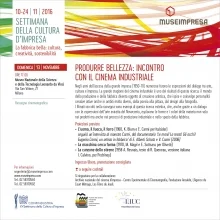
Producing beauty: industrial cinema

10–24 November 2016
BUSINESS CULTURE WEEK
The beautiful factory: culture, creativity, sustainability

SUNDAY 13 NOVEMBER, 5 pm

Museo Nazionale della Scienza e della Tecnologia Leonardo da Vinci
Via San Vittore 21, Milan

Film series PRODURRE BELLEZZA: INCONTRO CON IL CINEMA INDUSTRIALE (Producing beauty: industrial cinema)
In the years when big industry was on the rise (1950–70) there were many forms of dialogue between art, culture and business. The great season of industrial cinema was one result: the world of production and the factory became the subject of artistic creation, inspiring creative figures from very different fields, from poetry to painting, from design to photography. The films in the series are examples of this aesthetic research which, also through a dialogue with twentieth-century abstract art, explores the forms and colours of matter, not only in products but also in industrial processes and in the space of the factory.

Programme:

• L’uomo, il fuoco, il ferro (1960, K. Blum and E. Carmi for Italsider)
followed by an interview with Eugenio Carmi from the documentary Le mani! La testa! Gli occhi! Eugenio Carmi, un artista in fabbrica by E. Alberti Schatz and V. Carmi (2006)
• La macchina cerca forma (1970, M. Magrì and E. Sottsass for Olivetti)
• Le chant du styrène (1958, A. Resnais, text by R. Queneau, Italian version by I. Calvino, for Pechiney)

Free entry, booking recommended

Information:
segreteria@museimpresa.com
www.museimpresa.com
Tel. +39 02 58370544, +39 02 58370502

With thanks to: Archivio nazionale del cinema d'impresa – Centro Sperimentale di Cinematografia, Fondazione Ansaldo, L'Agence du Court Métrage, Les Films du Jeudi.

December 2015

Eugenio Carmi. Notes on Our Times. Historical Works 1957-1963

5th December 2015 - 28th February 2016
Due to its success the exhibition will be extended until the 13th of March 2016

Museo del 900, Milan

Exhibition Curator: Davide Colombo

Opening: Friday, 4th December - 6.30 pm

www.museodelnovecento.org

Eugenio Carmi, who was born in Genoa, but is Milanese by adoption, has decided to donate an important work of his, Appunti (Notes, 1963), to the city in order to confirm the close relationship he has with Milan.
The work he has donated is part of a cycle of works, Appunti sul nostro tempo (Notes on Our Times), that the artist executed in 1961 and 1963, when he was working as artistic consultant at the Italsider steelworks in Genoa, where he was responsible for publicity campaigns, advertising and the firm’s magazine.
Staged on this occasion in the Museo del Novecento, this exhibition is a tribute to the artist’s generosity, establishing a link between the collage and other works Carmi produced at that time. A series of collages, drawings and works on paper are on display, mostly for the first time, allowing us to fully appreciate his artistic output of the late 1950s and early 1960s.
This is an excellent opportunity to thank the artist, who, through his art, has helped to enhance the collections of the Milan Municipal Collections.

Claudio Salsi - Executive at Museo del 900