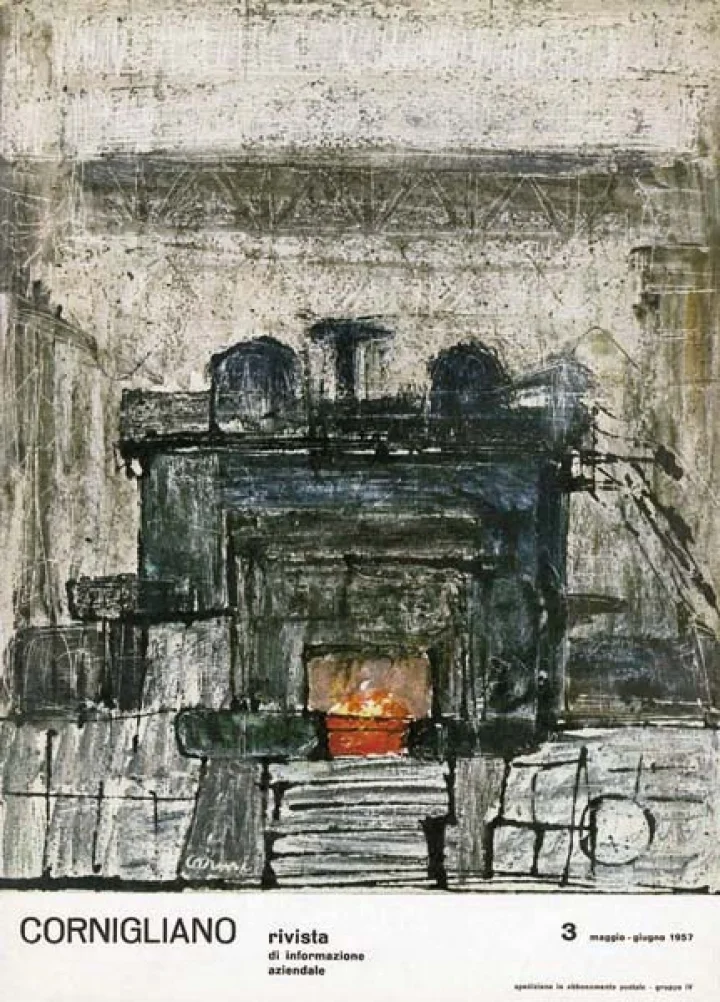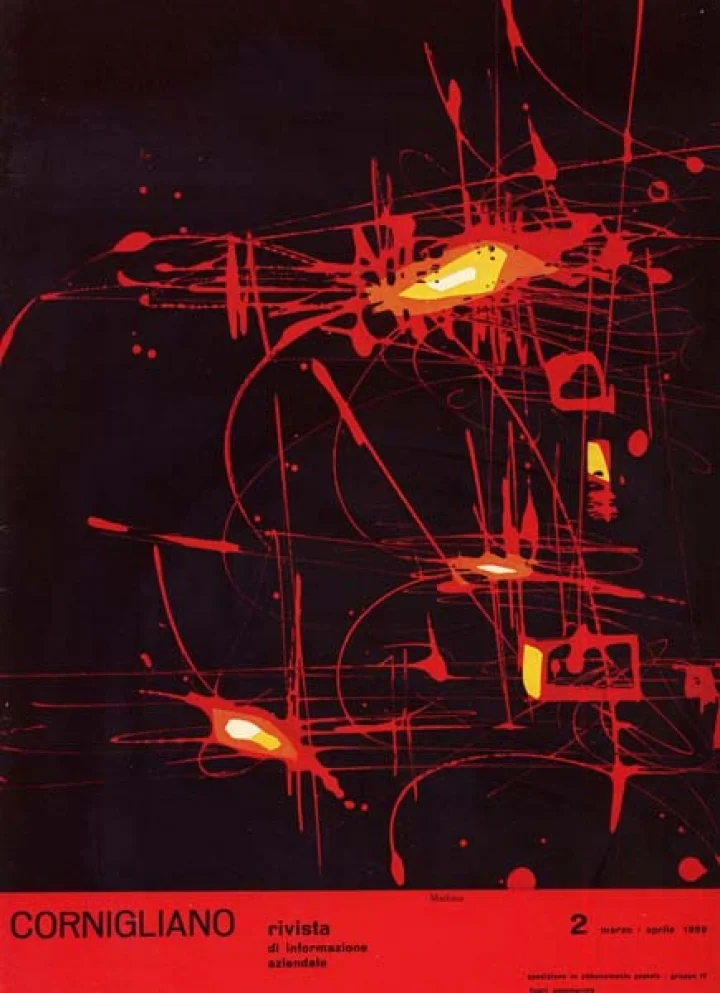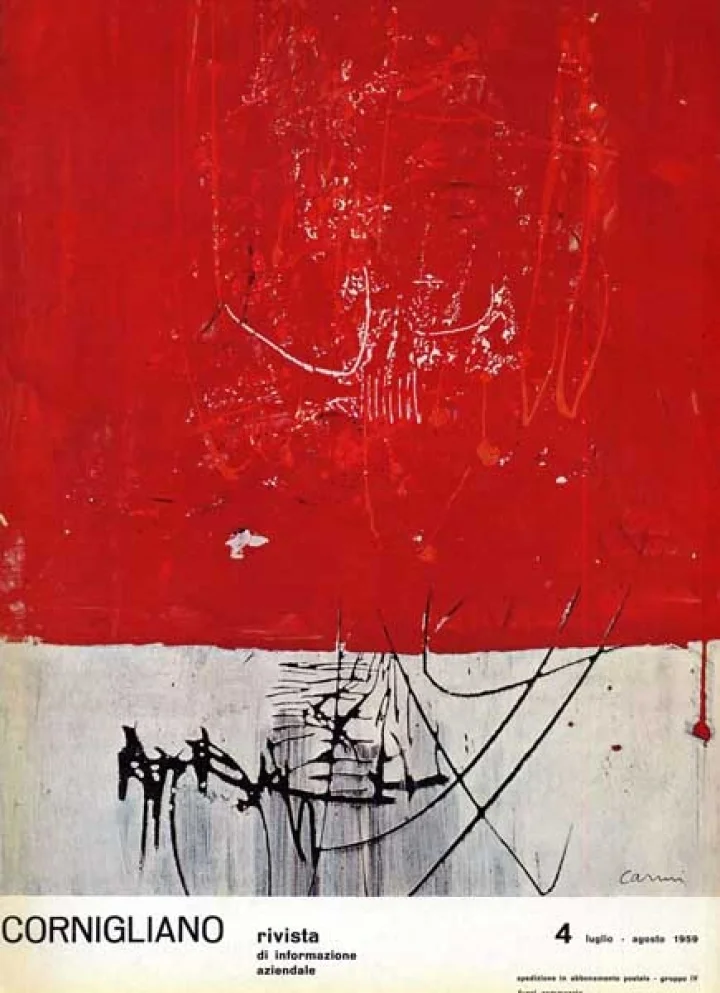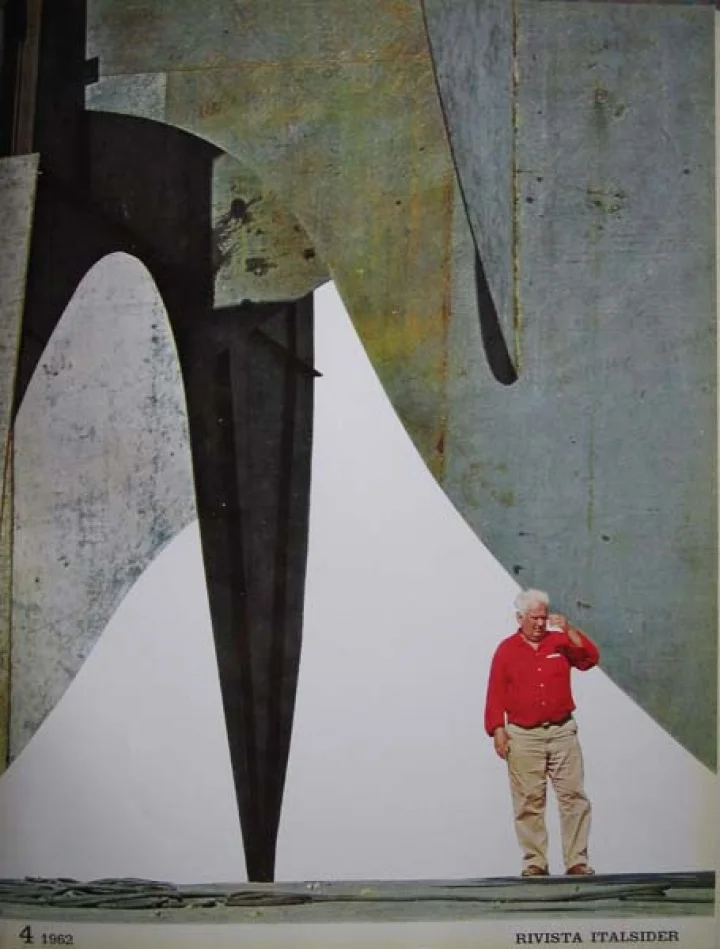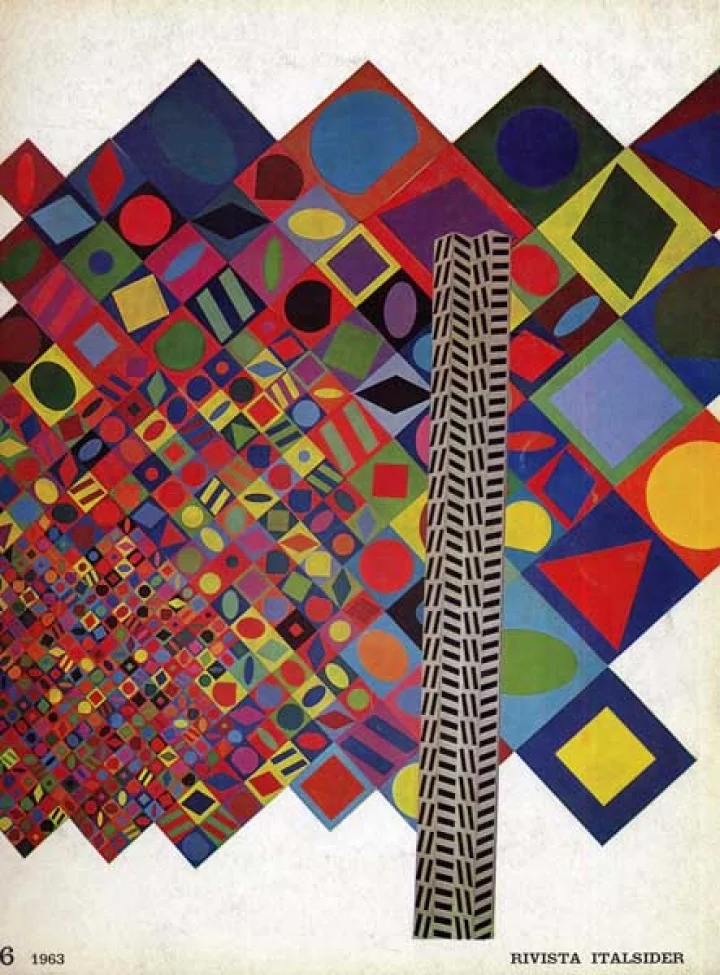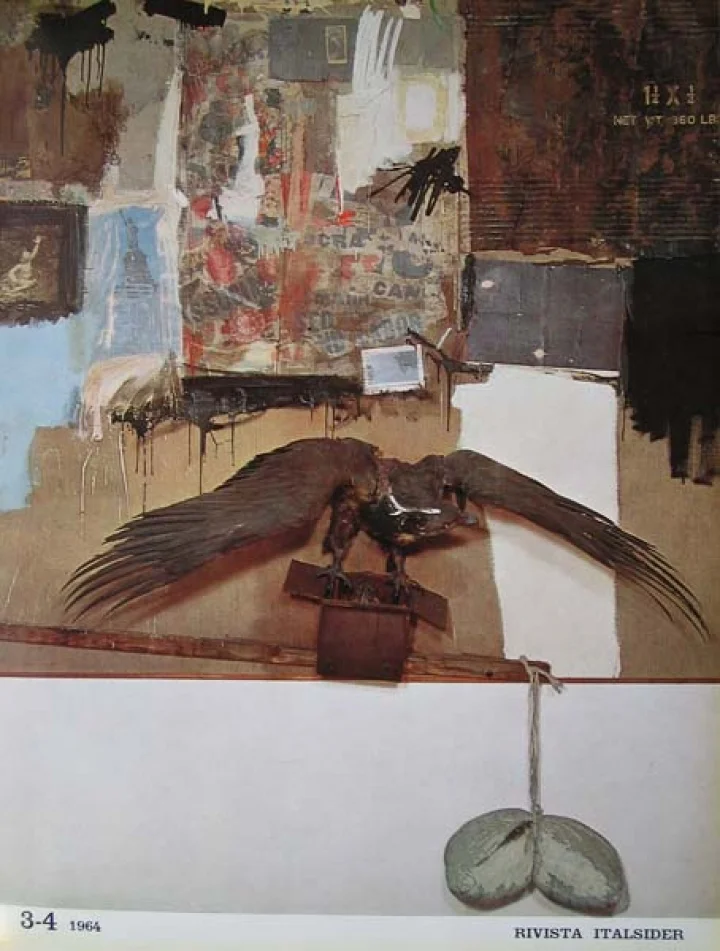
Carmi was immediately given the task of communicating with the public outside the industry through a campaign in the leading national and local newspapers. The idea was to show — using an avant-garde visual language — that steel could be the driving force behind the country’s modernization. In fact, he used the superimposition of negatives for the images and simple graphics with geometric insertions. For internal corporate communication aimed at the firm’s employees, a house organ, the Rivista Cornigliano was created. For the editing of the magazine, Carmi, who was its art director, enrolled the services of a young journalist working for ANSA (the Italian national press agency), Carlo Fedeli (in 1956 he became the head of the firm’s press office) with whom he worked on the layout of the magazine. This was the start of an extremely fruitful collaboration between Osti, Carmi and Fedeli — who shared the same cultural and social objectives and the same enthusiasm — that was to continue over the years. ‘I was very ambitious,… [it was necessary to create] an image for the steelworks that was modern and also strong, especially from a cultural point of view. This was what interested not only me but also Osti and Fedeli;… I started to design all the firm’s graphics, inviting numerous artists that I knew in Italy and elsewhere in Europe to create the covers of the magazines: they seemed to be the covers of an art magazine, while, in reality, they were those of a house organ…. This is because the firm’s image was always given great importance.’ From 1961 to 1965 Carmi’s industrial experience continued in a new company. On 27 April 1961 Cornigliano merged with another steel group, Ilva, to form Italsider SpA, which incorporated the Ligurian firm with other Italian steelworks — Bagnoli, Taranto, Marghera, Lovere, Savona, Novi Ligure, Piombino, Trieste, San Giovanni Valdarno and Campi — all under the central management of Gian Lupo Osti in Genoa. Eugenio Carmi and Carlo Fedeli — with whom he later founded the Galleria del Deposito — expanded and renewed the magazine, now known as the Rivista Italsider. Intended not only for the employees of the eleven steelworks, but also for a wider public, it became a publication with a high cultural profile and the contributions of a growing number of internationally renowned artists, intellectuals and photographers. The magazine’s graphic design was changed and one of the most important elements was the cover: formerly featuring the steelworks and its products, it now reproduced the works — some of them specially commissioned — of international contemporary artists, both well established and up and coming.
Rivista Italsider